

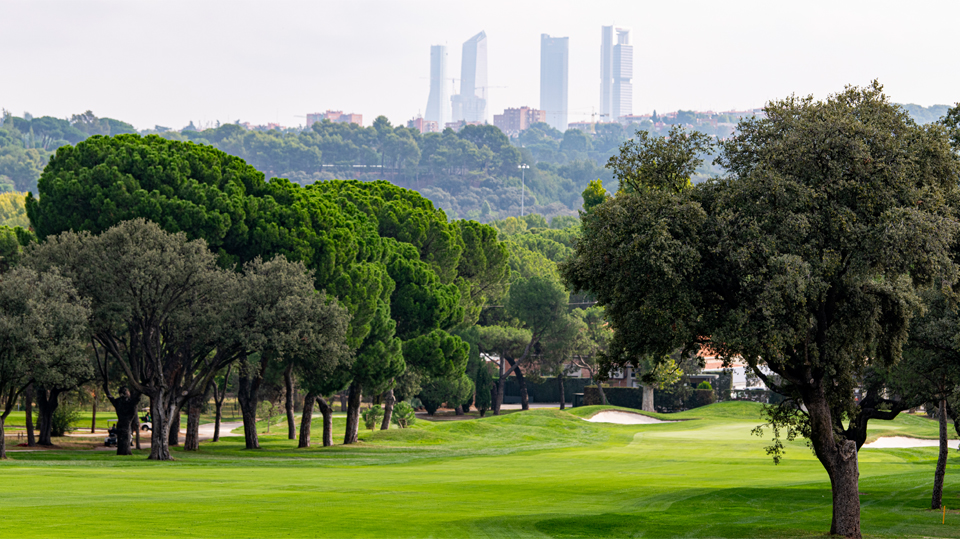
Alfonso Piñero, the maintenance and management team advisor at the Club de Campo Villa de Madrid, gives us an exhaustive guide to Javier Arana’s 18-hole layout. How should you play the course? What are its secrets? We take a hole-by-hole look at it:
Hole 1 (par 4): The tee has been moved back 18 yards, making the landing area more difficult for the drive, bringing the left-hand bunker into play. The shot requires a fade with a driver or a 3-wood, leaving a second with anything from a 6-iron to a wedge. A narrow and small green where the most difficult pin position will be the back-right.
Hole 2 (par 4): This tee has also been moved back, 21 yards in this case, now the left-hand bunkers (300 yards) are a factor. The second shot is similar to the one on the first, between a 7-iron and a wedge, to a more level green, with an easy pin position at the front and the most difficult in the middle on the right.
Hole 3 (par 3): The front flag is the most difficult because of how narrow it is, and if you miss on either side there is a good chance of a bogey or double. The long pin is more accessible because if you miss there is more room for recovery.
Hole 4 (par 5): 10 yards have been added to the tee, allowing the use of a landing zone at 285 yards. It becomes much more difficult into the wind, but otherwise this is a clear birdie chance. The rough on the right will be very tough during the Open de España, but if they avoid that area they won’t have any problems. The back-left pin is one to be wary of, we will see several three-putts there.
Hole 5 (par 4): A strategic hole because players can opt for an iron or the driver off the tee, depending on how tricky the rough on the left is. They will have a 7-iron to one of their wedges to the dance floor, depending on their strategy. A very tricky green, watch out for the back-right flag.
Hole 6 (par 4): Normally a 2-iron or hybrid from the tee to stay short of the stream, although some will opt for the driver to carry it, but this doesn’t reap much reward. As with most greens, the pin short of the tier is the simplest, but the back is very tricky.
Hole 7 (par 5): A recovery hole whose “new” tee from three years back leaves a bunker at 300 yards, but the big hitters will carry it without difficulty. They will have to be careful of the thick rough we have left on the left-hand side, as if the ball bounces on the downslope they could run into trouble. The pin positions at the back of the green are difficult because of all the undulations, which is in fact this hole’s biggest defence. There will certainly be a lot of birdies and the odd eagle here because they can hit the green with an iron.
Hole 8 (par 4): The simplest hole on the course, although there is trouble if the drive leaks right, as we have let the rough grow very long there. The middle-back pin is the most complex, although it should not present too much difficulty.
Hole 9 (par 3): They shouldn’t be hitting more than a 7 or 8-iron here. The lateral tier that splits the green makes the short-right pin position the difficult one, but if they are playing to the easy pin (left-hand side) and finish on the top tier, they will have to be very careful not to three-putt.
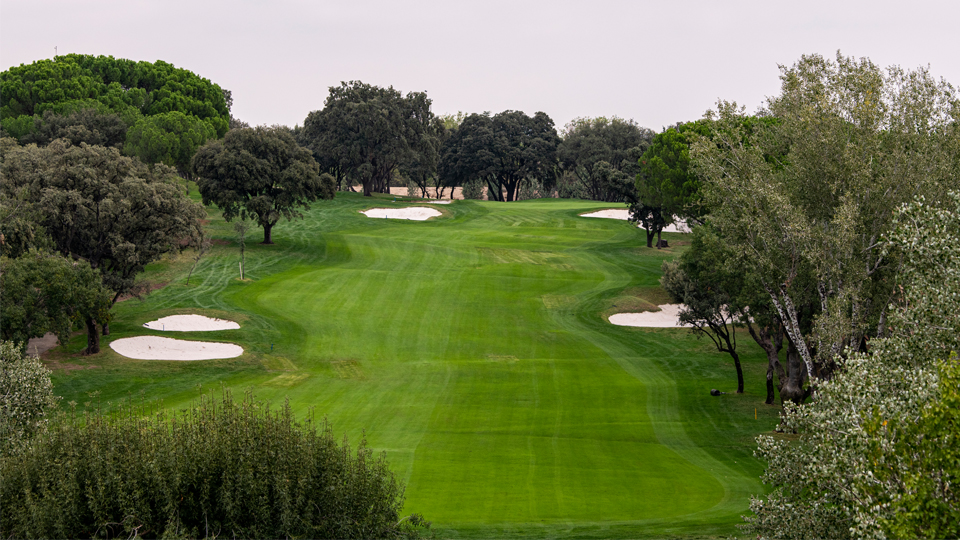
Hole 10 (par 4): There is a bunker at 300 yards that is difficult to carry because the rough will be very thick, therefore it is important to hit the fairway here. The green is very undulating and the difficult flag is centre-back, tight to the bunker. If you misclub, that bunker will make what seems a simple, short hole more complicated.
Hole 11 (par 3): The easy pin is front-left, but if they try to get too cute with it and miss the green, the drop-off we have made will take the ball a long way down. Careful with the middle-back flag, its contours will make even the shortest of putts difficult.
Hole 12 (par 4): The fairway bunker is an easy carry, but the holm oak in the middle of the fairway could hamper the second shot. If they miss left, they will have problems with another holm oak surrounded by high rough in the landing area. Players will have to use their heads on the tee, because strategy and accuracy are key, as if you nail your drive you will be left with a short shot, but if you miss it, it is a difficult par. The trickiest flag is bang in the middle, on top of a small platform.
Hole 13 (par 4): New tee, 14 yards back, like the 1st it demands a fade. The approach will depend on how dry the fairway is, but it will be no more than a 7-iron to a very uneven green with difficult pins at the back and in the middle. This green must be read carefully because it is often hard to see the breaks at a glance.
Hole 14 (par 5): Quite a simple tee shot to a wide fairway, although they should hug the left-hand side, and even carry the bunker, as if they land in the rough on the right it will be difficult to hit the green. The green sits diagonally to the fairway, almost forcing them to hit a fade, otherwise they will often find themselves in the bunkers. Not a clear eagle opportunity, but it is a birdie chance, however middle-left area of the green can be dangerous.
Hole 15 (par 4): Another short hole like the 8th, the danger here also lies in the right rough. If they hit a good tee shot, the only difficulty they may find is on the middle-right of the green, where the slopes will create a lot of problems.
Hole 16 (par 4): We’ve recovered an old tee here which is 21 yards further back, putting the bunker 300 yards away. We’ve created an area of very thick rough by that bunker, so the bail will be on the left, although that is where the ball will bounce the least. The second shot will be a little longer, possibly a 6-iron to a pitching wedge. The green is very narrow and the tricky pin is back-left.
Hole 17 (par 3): We have also lengthened this hole by 19 yards and it is now a very demanding shot, because we’re talking about the smallest green on the course. They will be playing between a 6 and an 8-iron and the toughest flag will be back-right because of the really tricky undulations in that area.
Hole 18 (par 4): The most strategic hole for the players, because we have let the rough grow up around the whole fairway. They’ll have to decide whether they want to play short or medium, or the big hitters may even go for it in one. The problem with the front flags on this hole is that if you don’t hit the green or get too much backspin, your ball could be swallowed up by the front drop-off and end up 45-55 yards away.
Note: The course has been lengthened by 118 yards compared to Javier Arana’s original design. They have tried to make it difficult with areas of very thick and high rough, but Alfonso Piñero himself reckons -20 could win it.