


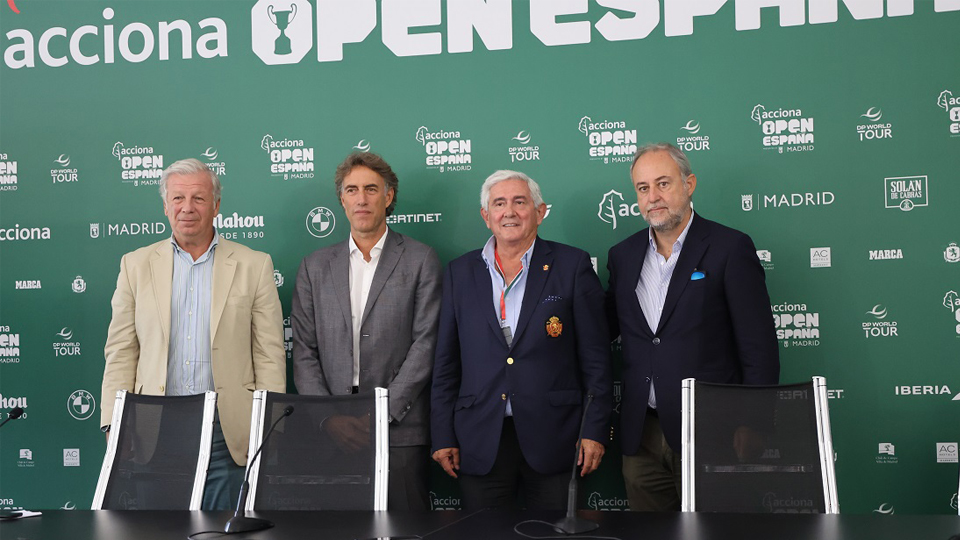
The golf industry is a model of sustainability and appropriate water usage; this is the message of Gonzaga Escauriaza, President of the RFEG, and Luis Nigorra, President of the AECG, to highlight the actions being championed by Spanish golf during the ACCIONA Open de España, a sustainable sports event promoted by Madrid Trophy Promotion and ACCIONA, who were represented by Gerard Tsobanian and Joaquín Mollinedo, respectively.
Concepts such as erosion and sedimentation control; soil conservation and improvement; subterranean aquifer recharge; temperature regulators; sulphur dioxide absorption and acid rain prevention; favourable habitats for the development of fauna and the containment of fires are part of the daily life of Spanish golf courses, which are investing increasing amounts into increasing the sustainability of their facilities.
In particular, in this regard, the implementation of new varieties of grass that require less water, watering control systems that target areas of play and the introduction to golf courses of natural firebreaks – which were seen to work this summer.
Tree planting, the installation of solar panels, the creation of electrical communities, the use of astroturf on driving ranges are all actions that, as Gonzaga Escauriaza noted, are already being implemented by Spanish golf courses, including the Centro Nacional.
Another important issue covered was water consumption, on which speakers correctly insisted that the watering of golf courses is unrelated to the water problem. These sports facilities are mainly (70%) watered with regenerated water that is unsuitable for human consumption, which undergoes biological treatment so that it can be reused on golf courses instead of being poured into aquifers or the sea, which creates its own ecological issues. It is for this reason that the National Water Pact does not consider water consumption by golf courses to be significant in comparison with sectorial or global usages.
Some statistics were given in this regard: the direct and indirect economic impact of golf is 12 billion euros a year; Spain attracts 1.2 million foreign tourists and has consolidated itself as the world leader in terms of international golf tourism; the sector generates over 120,000 direct and indirect jobs, most of them in quality employment; 7 of every 8 euros (88%) produced are generated off the golf course, impacting other sectors such as services – demonstrating the importance of the golf industry to Spanish society as a whole.
Gonzaga Escauriaza, President of the RFEG, stated that “the large number of courses that use regenerated water that is unsuitable for human consumption contributes to the generation of wealth, since it allows an activity to be carried out which helps to deseasonalize tourism. For this reason, we ask the Administrations to serve the golf industry, which has demonstrated clear environmental awareness for years, bringing social and economic benefits, since it generates over 5.6 billion euros directly for Spanish society as a whole”.
The President of the RFEG also pointed out that, in relation to certain information, “our job is not to respond to certain things. We hear criticism that is frankly false, lies. In this sector we are constantly doing things to improve and as a whole we are very favourable to society. We have to work to communicate the benefits of golf. By way of example, cases such as the Centro Nacional, which has become a wonderful green habitat. That is what we do and we have very strong arguments”.
For his part, Luis Nigorra, President of the Spanish Association of Golf Courses, noted that “golf is a deseasonalizer as it is mainly played outside the summer months, which helps make tourist activity more sustainable by promoting activities outside of the ‘sun and beach’ season. This means that activities that are complementary to golf also benefit and can carry out their activity for many more months. It should be remembered that, also, golf is a tourist product with a great multiplying effect, since 7 of every 8 euros spent by golf tourists are spent off the golf course.
The President of the AECG explained that “the water issue needs to be addressed regionally, not nationally. We are all worried about the drought, but the focus needs to be elsewhere. Every day, at the distribution networks, six times the water consumed by all our golf courses together is lost, and that is drinking water. Therefore, in terms of droughts, we shouldn’t be looking at golf, which, I repeat, uses mainly recycled water which is not suitable for human consumption”.
When it was his turn to talk, Gerard Tsobanian, CEO of Madrid Trophy Promotion, the tournament organisers, stated that “there is a need to fulfil our responsibilities. This initiative began in 2020, but it is a long process and we take it very seriously. We either do things well or we don’t do them at all. Sustainability is the DNA of Madrid Trophy Promotion, which is why we have brought together experts in the sector, such as the ACCIONA engineers. We see things such as the drought, storms, hurricanes… and they lead us to think that we have to contribute in some way. For example, you will not find any plastic at this tournament, our cars are all electric, paper is not used, the hoardings are recyclable, next year we’re working on a bio fertilizer that does zero damage to the soil… we employ realistic measures, we don’t do marketing”.
Finally, Joaquín Mollinedo, General Director of Institutional Relationships, Communication and Brand at Acciona, highlighted that “we have always been interested in sport because of its values. We wanted to bring this message and the commitment to sustainability into sport: ours was the first electric car to reach Dakar, for example. From day one, we all understood that we had to put on a sustainable event, so that anyone who comes to it knows that it is not only a competitive event, it also has a message and a commitment. This translates into real, specific measures that are measured and which transform the environment from a social point of view, such as with electric transport, the generation of clean energy, energy efficiency, other means of biodiversity protection, waste collection plans, etc. As well as achieving net positive CO2 emissions”.


